

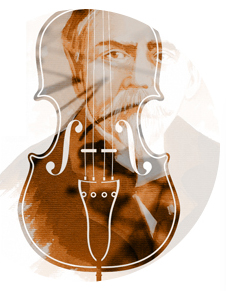
JENŐ HUBAY
BIOGRAPHY
Jenő Hubay was born on 15th September 1858 in Pest (now Budapest). He changed his original surname Huber to the more Hungarian-sounding Hubay when he was 21 years old. He studied violin first with his father, Károly Huber (1828–1885), leader and conductor of the orchestra at the National Theatre, and violin professor at the National Conservatory. From the autumn of 1873 Hubay continued his studies in Berlin, with the most distinguished violin teacher of the period, Joseph Joachim. In the spring of 1876 he completed his studies and returned to Hungary. Here became friendly with Franz Liszt, and gave together several performances of the 12th Rhapsody and Beethoven’s Kreutzer Sonata.
In May 1878 Hubay travelled to Paris on Liszt’s advice, and was soon to be a favourite guest in the musical salons of the city. In the next years he made successful concert tours in France, England, Belgium, the Netherlands and Hungary. Soon after he arrived in Paris he got to know Henri Vieuxtemps who saw in the young Hungarian the continuation of his own artistry. Summer 1881 Vieuxtemps suggested Hubay as Professor of Violin at the Brussels Conservatoire, a post which he himself and more recently Henryk Wieniawski had held. In 8th February 1882 the Belgian King appointed Hubay to one of Europe’s most important musical posts.
Hubay spent four and a half years there, returning in the summer of 1886 to Hungary at the request of Liszt and the Minister of Education to take up the post as head of the violin school in the Budapest Academy of Music. He settled in Budapest, and exchanged his life as a travelling virtuoso for that of composer and leading personality in the musical life of Hungary. From 1919 to 1934 he was the Director of the Budapest Academy of Music (from 1925 – after Hubay’s advice – the institution bears the name of Liszt. Today F. Liszt University of Music.).
Here he created one of the world’s leading violin schools. After the turn of the century the first exceptional talents to emerge were Stefi Geyer, Ferenc Vecsey and József Szigeti, to be followed by Emil Telmányi, Eddy Brown, Jelly Arányi, Jenő (Eugene) Ormándy, János Koncz, István Pártos, Erna Rubinstein, Ilona Fehér, Zoltán Székely, Ede Zathureczky, Endre (André) Gertler and Wanda Luzzato. Similarly, a long line of string quartets, such as the Waldbauer–Kerpely, the Hauser–Son, the Léner, the Roth and the Végh quartet, emerged from Hubay’s department.